The material memoir of a home
What can a life be remembered through?
At Tulkiyan, some of the most revealing answers are found in the smallest things. Among and within the furnishings are countless trinkets and pieces of ephemera: a souvenir or keepsake, a handwritten note, a photograph, a ticket, a small ornament or an everyday object that might otherwise seem unremarkable.
These are the things that were kept - and, in being kept, they became part of a personal story.
Together, the objects in this collection allow us to trace the lives of the Donaldson family, who called Tulkiyan home for eighty years. They offer glimpses of relationships, interests, habits, travels and experiences, revealing aspects of personality and everyday life largely unrecorded in letters or official documents. These small objects evoke a person, a place or a moment long after the original memory has faded.
This collection is therefore more than an assemblage of possessions. It is a record of attachment and memory: a gathering of the things that accompanied the people of Tulkiyan through their lives, reflecting what they noticed, enjoyed, remembered and chose to surround themselves with.
This exhibition invites you to look closely at these traces. To consider the stories held within ordinary things, and to discover how, when brought together, the smallest fragments of a life can reveal something of the person behind them.


Dozens of surviving receipts relating to the building and furnishing of Tulkiyan provide an unusually detailed record of the home’s creation. Together, they offer remarkable insight into the Donaldsons’ planning, decisions and personal tastes, tracing the choices through which the house gradually became their home.
Made from simple hessian and used as a cushion for kneeling while weeding, this practical object speaks to the everyday work of maintaining Tulkiyan.
The house is filled with modest, useful things such as this—objects made to serve a purpose and sturdy enough to endure years of use.
This Mungo Scott flour sack has a particularly personal connection to Tulkiyan: Mary Donaldson was the daughter of Mungo Scott, founder of the milling business that bore his name.
The firm later became closely associated with its landmark flour mill at Summer Hill, built in 1922 and a familiar part of Sydney’s industrial landscape for generations.
Today, the former mill has been reimagined as the Flour Mill of Summer Hill, a mixed-use heritage precinct in which the historic Mungo Scott building and silos have been retained and adapted for new uses.
This humble flour sack connects Tulkiyan’s domestic life and family history with a much larger piece of Sydney’s industrial heritage.
Decades of sewing, repairing and mending at Tulkiyan have left behind a wealth of sewing supplies, evidence of the everyday work involved in caring for a household. This sewing box, with its beautifully embroidered floral lid, is one of many handcrafted objects in the collection that bring beauty and individuality to otherwise practical things.
Tulkiyan’s kitchen is filled with a collection accumulated over decades: hardy, elegant and practical instruments of the culinary arts. These whisks, vegetable masher and colander are examples of the quality and durability of everyday kitchenware from decades past—well-made objects that, despite years of use, could still serve their original purpose today.


Tulkiyan is filled with decades’ worth of cardboard boxes—original packaging from purchases that was carefully repurposed for household storage.
Together, they form an unexpected record of Sydney’s retail history, preserving the names of shops, manufacturers and products that once formed part of everyday life.
This hat box is an excellent example, produced for Anne Collins, a Sydney millinery house active from at least the late 1920s; surviving Anne Collins hats are now held in museum collections.
Like so many ordinary objects at Tulkiyan, packaging that might usually have been discarded has survived to tell another story.


Calendars and diaries appear throughout Tulkiyan, reminders of a pre-digital age when appointments, anniversaries and everyday events were recorded by hand.
Often beautifully designed, they were decorative household objects as well as practical ones. This pocket calendar for 1914 is inscribed “To Meg, with love.”
Meg was Margaret Donaldson, the youngest of the three Donaldson children, who lived at Tulkiyan for eighty years and ultimately ensured its preservation for the community.
These colourful embroidered pieces are thought to be dress trimmings, possibly a detachable collar and matching cuffs, dating from the late nineteenth or early twentieth century. Decorative handmade embellishments such as these could be carefully removed when a garment wore out or went out of fashion, then saved to adorn another.
Their survival at Tulkiyan reflects an era when clothing was altered, repaired and reused, and when a particularly beautiful piece of handwork might be treasured long after the garment itself had disappeared.


Two very different artists’ paint sets survive at Tulkiyan, evidence of the creative interests of the Donaldson household. One is a compact metal watercolour box made by George Rowney & Co., the celebrated London artists’ colourmen whose paints, brushes, palettes and drawing materials were used by professional and amateur artists around the world. Rowney was producing portable watercolour and sketching sets by the nineteenth century, designed to keep an artist’s colours and mixing palette conveniently together.
Alongside it is a larger fitted wooden artist’s box, containing paints and other painting materials. Both sets show signs of use and may have belonged to Mrs Mary Donaldson, an avid amateur painter and supporter of artists, or to another member of the household. Preserved with their pigments and equipment still in place, they provide a wonderfully tangible record of the practice and appreciation of art at Tulkiyan.
This sturdy tin hat box, designed to protect a hat while travelling, is marked “Miss Peters” and was used by Sarah Peters, the Donaldson family’s long-serving housemaid and companion. Sarah lived at Tulkiyan from its earliest years and remained closely connected with the family for the rest of her life.
Sarah travelled with Mrs Mary Donaldson on at least one occasion, writing a warm letter home to the young Margaret describing their journey. The hat box is a particularly personal reminder that Sarah’s life at Tulkiyan extended well beyond her daily household duties, encompassing travel, companionship and enduring relationships with the family.

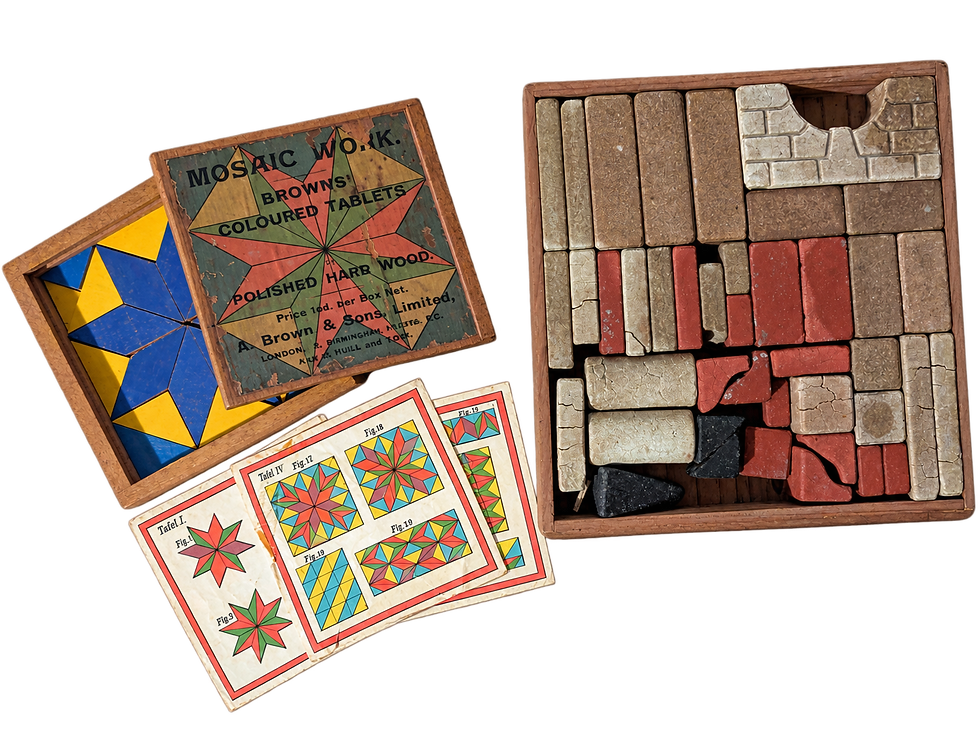
These toys offer a rare glimpse of childhood at Tulkiyan and may have belonged to William Donaldson Junior, known as Bill. The miniature flags, together with colourful puzzles and building blocks, belong to a period when children’s toys frequently combined amusement with instruction. Building sets and puzzles in particular were valued for encouraging dexterity, imagination and constructive play.
Carefully kept long after childhood had passed, the toys are another example of the remarkable survival of everyday family possessions at Tulkiyan. They evoke the children who grew up in the house and the quieter hours of play that formed part of its domestic life.

One of the Union Jack flags is slightly larger and is marked “Our Day”, identifying it as a likely First World War fundraising flag. “Our Day” appeals raised money for the British Red Cross and Order of St John, with small flags and other tokens sold to the public. Its survival at Tulkiyan is a small but evocative reminder of the ways in which the war entered everyday domestic life.